

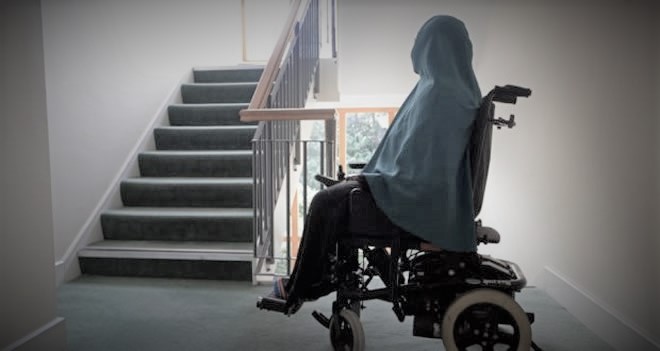
Recent government statistics show a sharp rise in all hate crimes, including those targeted against the disabled. In 2016, there were 3,629 reported cases of disability hate crimes.[1] In fact, the actual number may be significantly larger than reports would suggest due to the reluctance on the part of the victim in reporting the crime in the first place, and problems faced by the police force in defining disability. If the disabled are viewed as vulnerable and disadvantaged, then why are they seen by some as ‘soft victims’ and are subject to verbal and physical attacks? What do we understand by the term ‘disability’ and how can we attempt to change attitudes?
Defining disability
A person may be disabled if they are impaired, either physically or mentally, under a wide range of medical conditions. Thus, they cannot have a fulfilled life and are dependent on support to address their needs. This outlines the traditional view and thus, some consider disabled people as a strain on resources, on the fringe of society and a burden for the able-bodied. Consequently, the public have differing approaches to disability: pity, awkwardness or arrogance. Most people are embarrassed by their lack of knowledge and experience which affects their attitude to the disabled. The charity, Scope, emphasises this point:

‘Barriers are not just physical. Attitudes found in society based on prejudice or stereotype, or disablism,[2] also disable people from having equal opportunities to be part of society.’[3]
Organisations such as #ImWithSam are campaigning to raise awareness of the plight of those who are mentally or physically challenged, to address negative attitudes to the disabled, to try to tackle the root causes of hate crime aimed at them, and to try to make positive changes in the training of professionals in the fields of education, in the NHS and in the police force to improve and adapt resources to support the disabled.[4]
The Social Model of disability
Recent studies have suggested a dramatic rewording of the definition of disability from the perspective of society: concluding that a person with impairments is disabled from participation in social activities, because of the social structure and organisation. In other words, society itself imposes constraints on the person. If these constraints were addressed then, in a sense, the person would still be impaired but would no longer be “disabled” from being an active member of society. Impairment is thus defined as lacking all or part of a limb, or having a defective limb, organ or mechanism of the body. Thus, a new definition of disability would be:
‘the disadvantage or restriction of activity caused by contemporary social organisation which takes no or little account of people who have physical impairments and thus excludes them from participation in the mainstream of social activities.[5]
The onus is therefore placed on the shoulders of society to include people who are physically or mentally impaired in mainstream spheres of society, and to establish their ‘seven needs’ of: information; counselling; housing; technical aids; personal assistance; transport; and access.
Positive discrimination in the workplace
It is thought that in the UK, there are seven million people of working age who are disabled.[6] It would be of great benefit to businesses to encourage recruitment of disabled people, with adaptations in place, as required. In addition, there are a growing number of people with disabilities setting up their own businesses:
‘Diversity in a workforce has long been said to be beneficial to a company. The need to reflect your customer base within the workforce brings empathy and understanding, and far from being a hindrance to a business, this diversity can bring a strength. The bigger difficulty for many is the barriers that other people put in the way. Advances in access technology have taken away many of these physical barriers, but there’s still a lot to be done to take away the social ones.’[7]
Disability and the Muslim Community
It is well known that the Prophet (sall Allāhu ʿalayhi wa sallam) appointed the blind companion ‘Abd Allah b. Ummi Maktum (radiy Allahu anhuma) in charge of some affairs of Madinah, on more than one occasion, when the Messenger was called away for battle. In so doing this, the Prophet (sall Allāhu ʿalayhi wa sallam) looked to the skills of the man, beyond his visual impairment which he did not see as being a hindrance to his abilities for leading the people in prayer, calling the adhan, and so on. This is a great model for us to follow. It is true that the disabled are subject to a great test from Allah (subhana wa ta’ala) but the same is true for the able-bodied and we are tested on the way we respond to and support all types of needy and disadvantaged. Furthermore, each and every one of us has the potential to surpass his tests, with the Mercy of Allah (subhana wa ta’ala).
The “Disabled” are an asset to us
Disabled people are an asset to society; rather than focussing on their impairments, employers and the public in general should look at what they can offer – talents and skills. Able-bodied people may find it hard to connect with those who are disabled. As with other minority groups, there is a superficial ‘us and them’ culture. Lack of knowledge and understanding may lead to fear, anger and hatred, especially for those looking through a materialist lens. From an Islamic perspective however, we have a different lens to see this relationship through.
‘You are given victory and sustenance due to the weak amongst you.’[8]
‘Allah only gives victory to this Ummah because of its weak; because of their supplications, their prayers and their sincerity.’[9]
Muslims realise that rizq comes from Allah, and although an ignorant person may feel unhappy that their wealth is being used up by those relying on them, a wise person will realise the causal relationship between our success and those who depend upon us. In addition to this, those with physical impairments have been created for a great wisdom by Allah, to fulfil a noble objective. In the famous event of the mithaq (Covenant), when Adam (‘alayhi al-Salam) saw all of his progeny before him when testifying to Allah’s Lordship, various narrations mention that he saw some of his progeny with physical afflictions and impairments. When he asked Allah about them, Allah said: I love to be thanked.[10] When looking at those whom Allah has tested with their health or their physical abilities, it should be reminded to be grateful to Allah, which includes using the ability he has given us to serve him and His beloved creatures.
As for wider society, one prime manner to ‘normalise’ the role of disabled (and other minority groups) in society is more visibility and social engagement. Broadcasters should not shy away from recruiting the disabled to present the news, and so on. The Council of Europe’s Disability Action Plan (2006) states:
“Disabled people need to be present in advertising, on screen, on radio and in print to bring about a paradigm shift in perception for disability and disabled people; a real change in attitudes by all members of society can then become a reality.”[11]
In the Muslim Community, as mosques re-align themselves as the hubs of their communities, they need to reach out to all the faithful. It is not for me to dictate what measures mosques need to put in place to promote inclusion but a suggestion is to have an open forum, maybe monthly, where the congregation can put forward any comments, complaints, criticisms or compliments.
Our whole society should take on the responsibility of integration of citizens of all abilities to fulfil the mandate for equal opportunities for all. As for within the Muslim community, we have to re-ignite the vision of inclusion, unity and brotherhood stressed upon us. As Abu Hurairah (radiy Allahu anhu) narrated, Messenger of Allah (sall Allahu ‘alayhi wasallam) said,
“Allah does not look at your figures, nor at your attire but He looks at your hearts and deeds.”[12]
[donationbanner]
Source: www.islam21c.com
Notes:
Further reference: Disability and the Muslim community
http://cirrie.buffalo.edu/culture/monographs/muslim/
[1] http://report-it.org.uk/files/hate-crime-1516-hosb1116.pdf
[2] http://www.scope.org.uk/support/professionals/teaching-disability-history/lesson-plans/disablism
[3] http://www.scope.org.uk/about-us/our-brand/social-model-of-disability
[4] http://online.dimensions-uk.org/JoinImWithSam?_ga=1.89950174.438184796.1487330203
[5] http://disability-studies.leeds.ac.uk/files/library/DavisK-DavisK-davis-social-barriers.pdf
[6] http://www.dlf.org.uk/content/key-facts
[7] http://www.bbc.co.uk/news/business-38962050
[8] Bukhari
[9] Al-Nasa’i
[10] As relayed by many scholars including Ibn al-Qayyim in Kitab al-Ruh
[11] http://www.disabilityplanet.co.uk/social-barriers-and-ethical-issues.html
[12] Muslim


‘You are given victory and sustenance due to the weak amongst you.’
This is our deen; our treatment and importance given to them,
alongwith what islaam already gives them, as can be seen by this hadeeth from al bukhaaree and further from that in nasa,ee
‘Allah only gives victory to this Ummah because of its weak; because of their supplications, their prayers and their sincerity.’
Our religion is just totally beyond overwhelming.
JazaakiAllaah khayraa for touching on this subject; absolutely crucial for us muslims.
The example in this century from the many has to be the shaykh umar abd al rahmaan rahimahuallaah.
This blind shaykh of par excellence not only outdid others in studies but participated in jihaad in the mountains of afghaanistan and was further imprisoned by the yanks in the US and died there
Whether known or unknown we do need to try harder in our helping them