In collaboration with

In collaboration with
A Fax That Changed Everything
A
Fax That
Changed
Everything
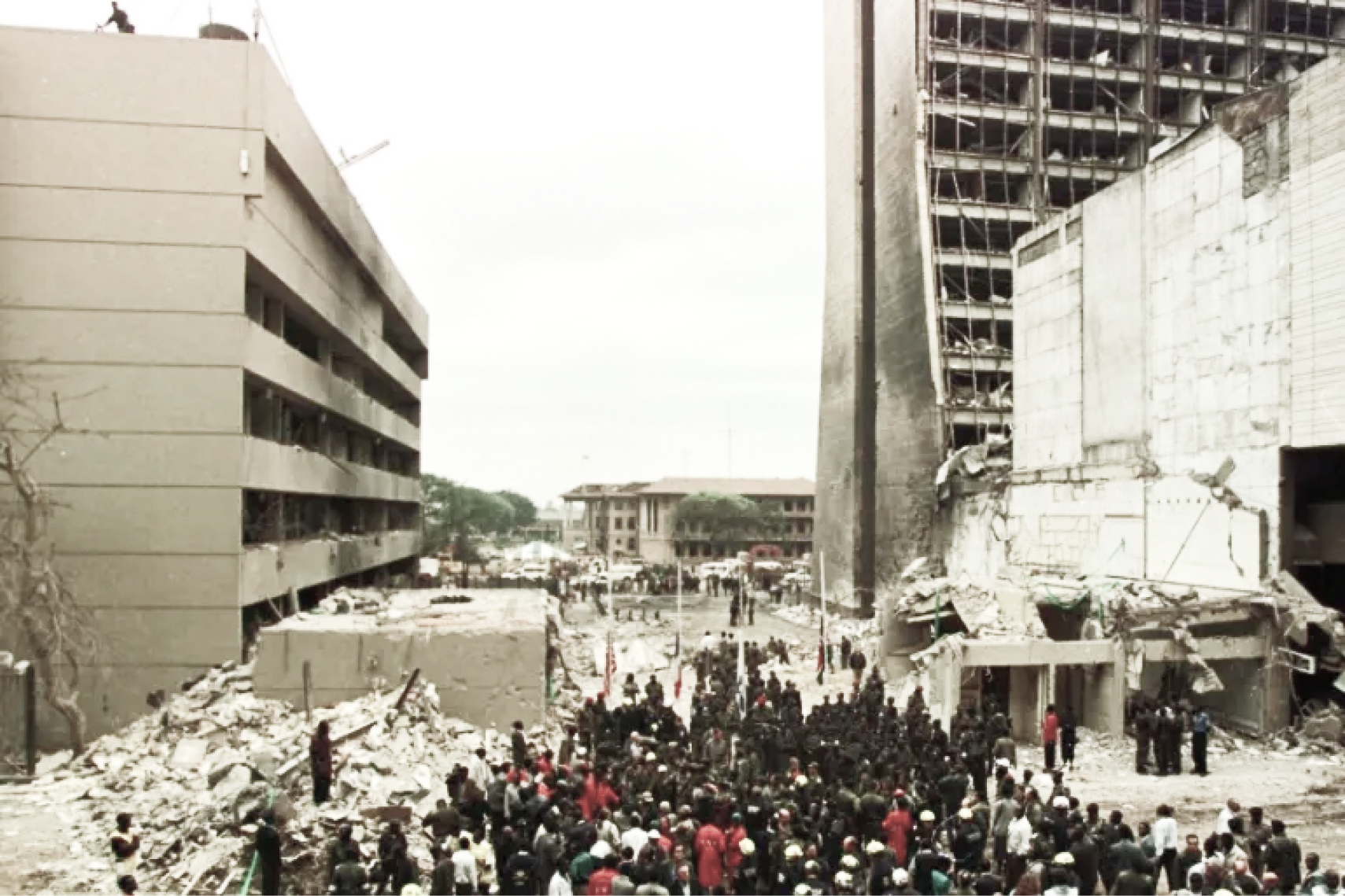
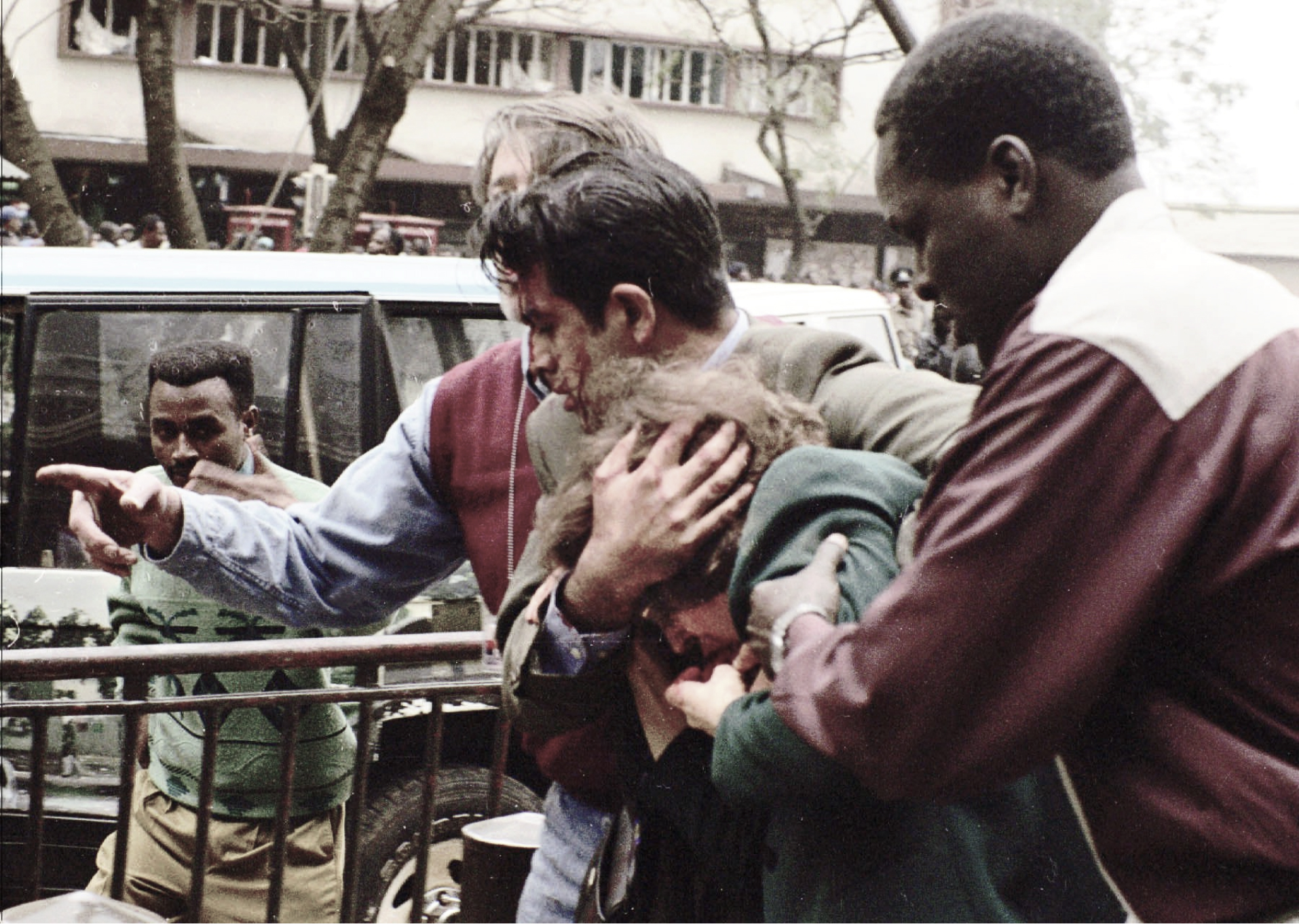
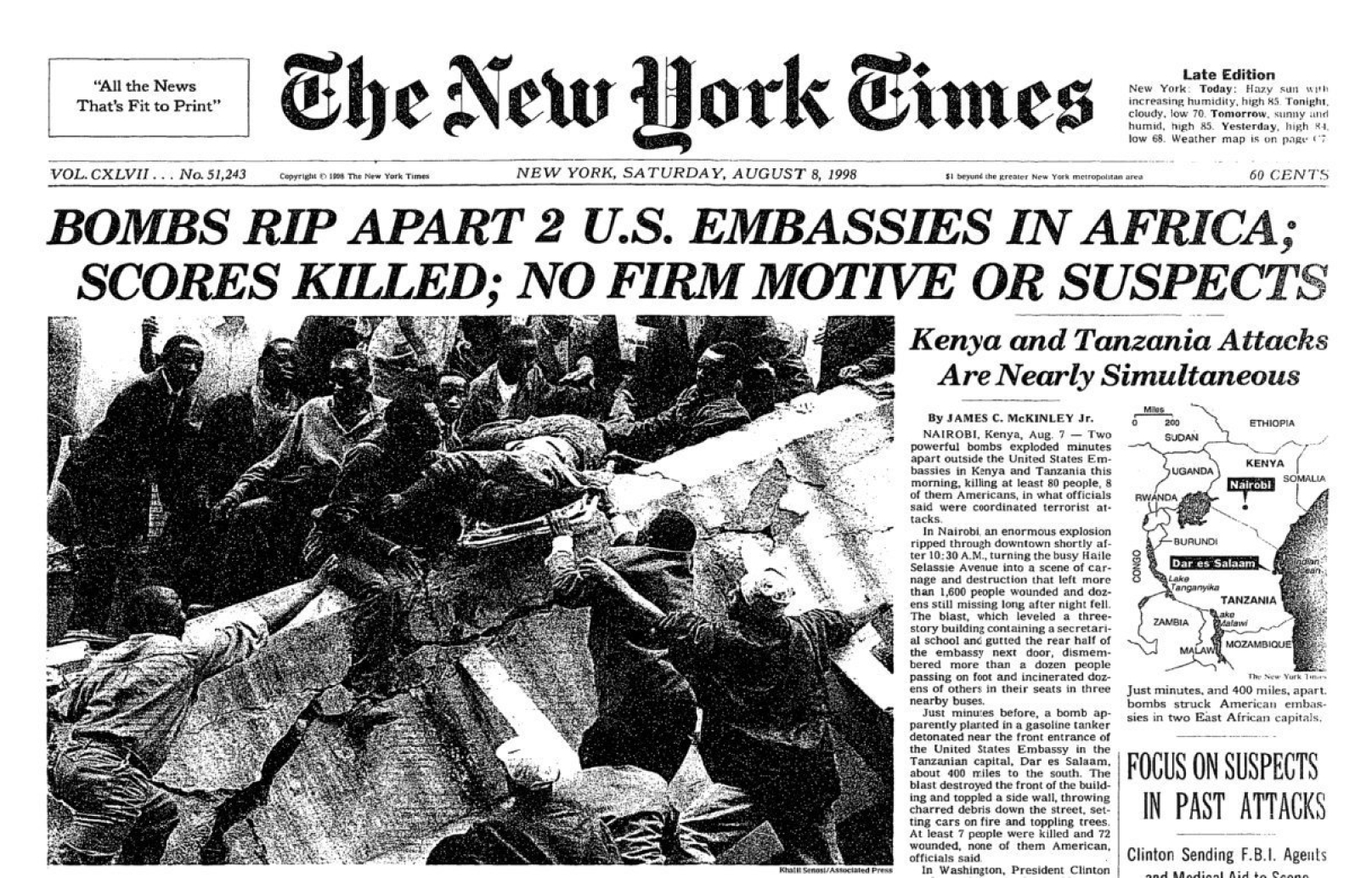
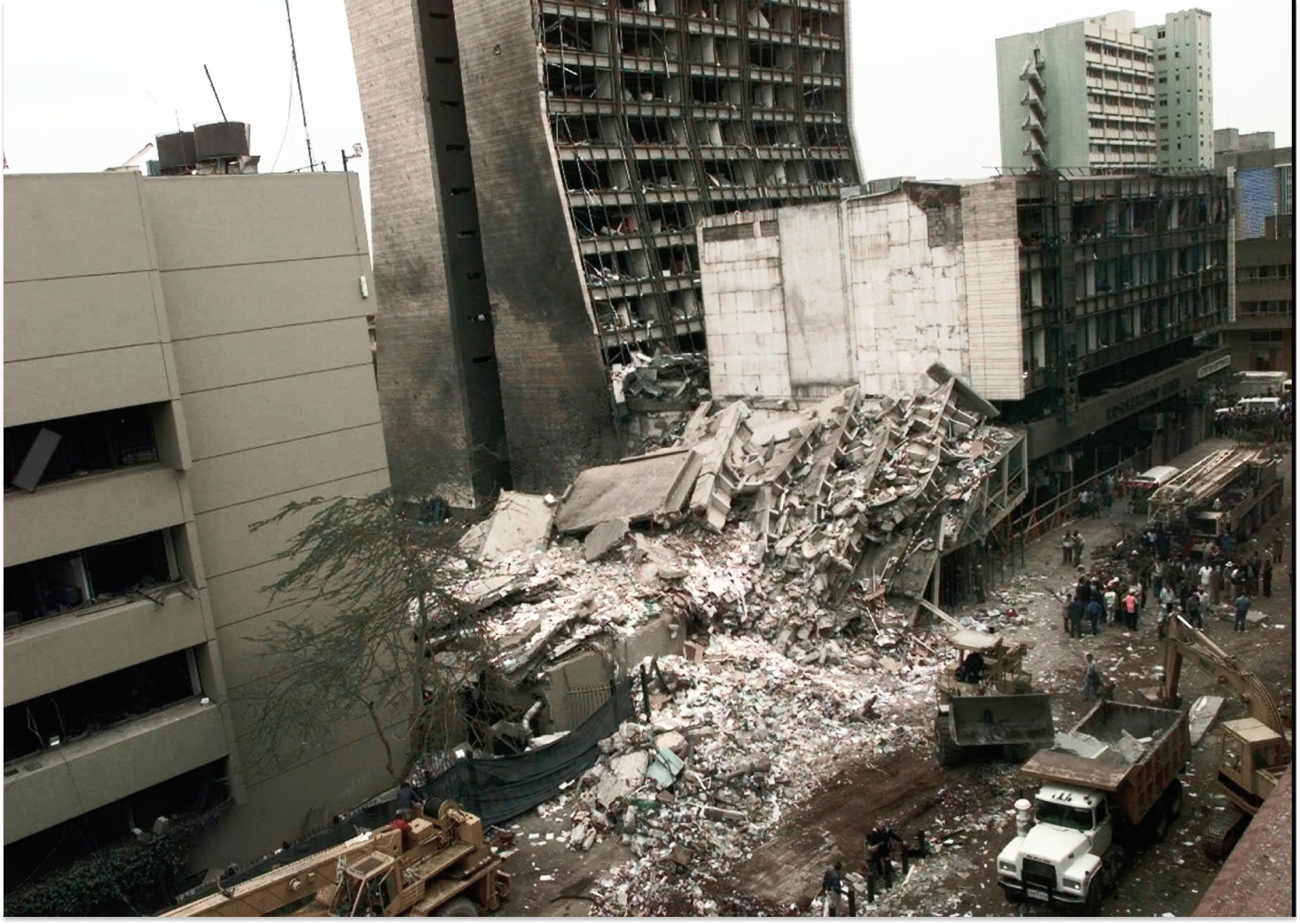
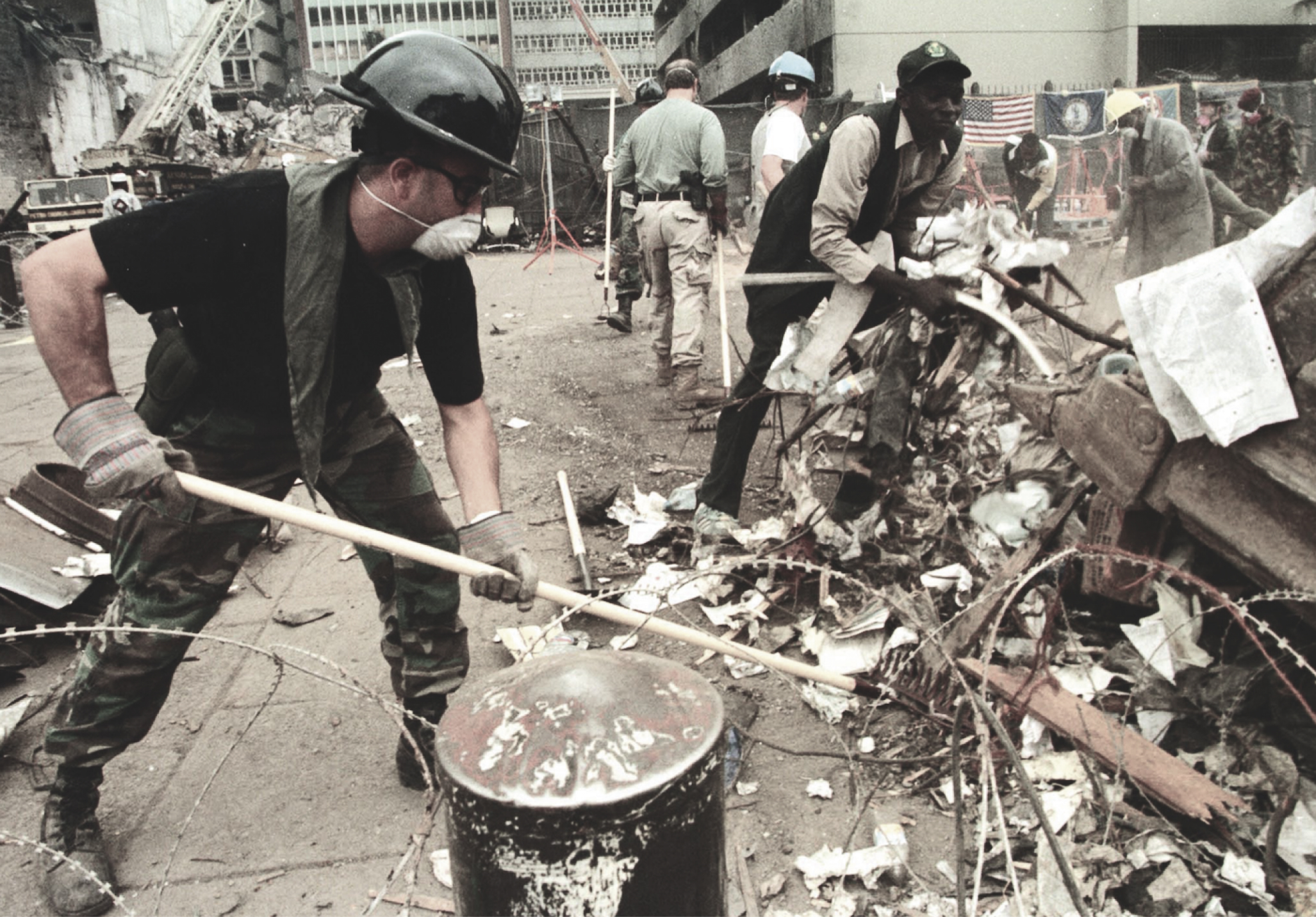
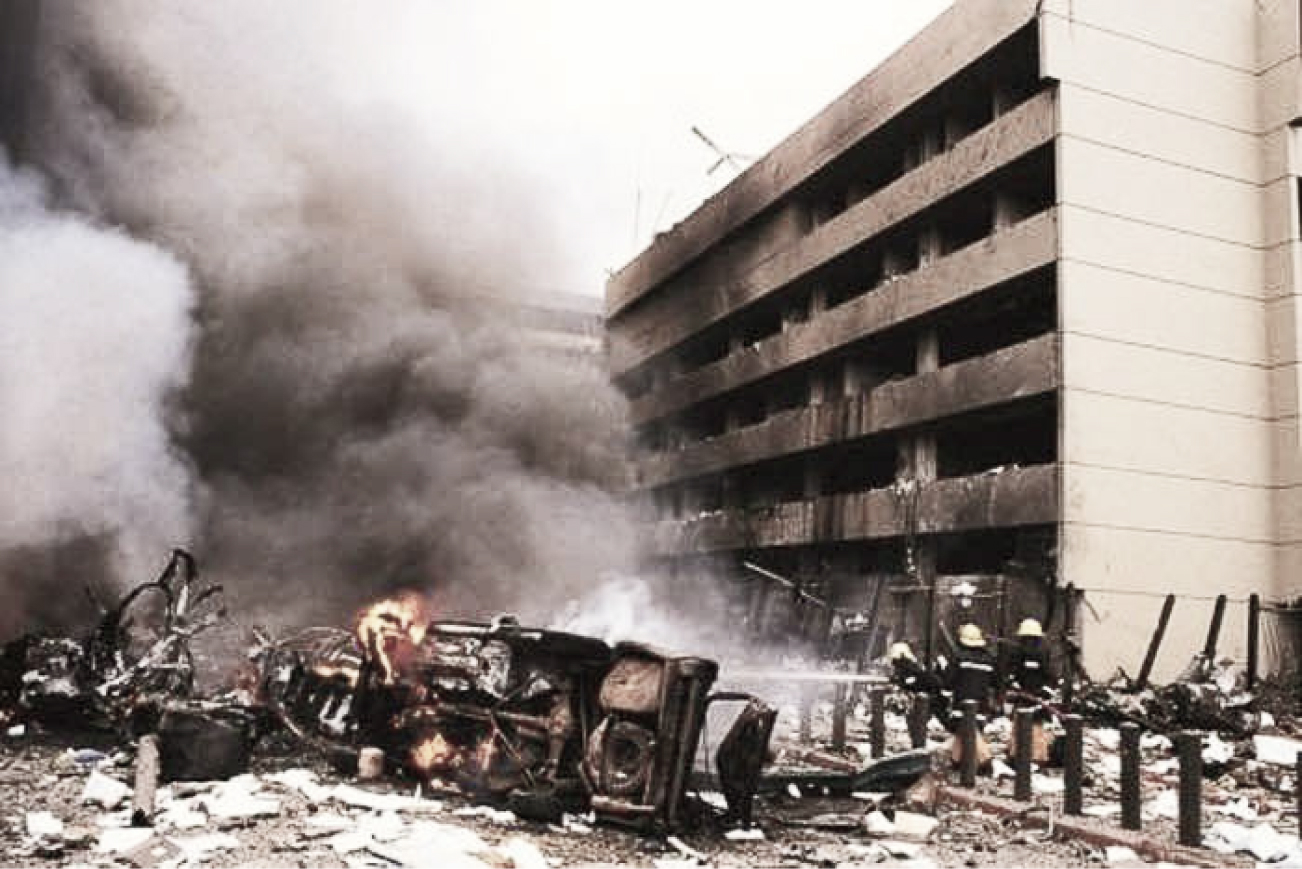
On 7th August 1998, al-Qaeda blew up the US embassies in Kenya and Tanzania, killing 220 people and wounding nearly 5,000.
Adel’s office was running like any other normal day, receiving letters, calls, and faxes from press agencies around the world.
When the bombings struck, the media frenzy to secure a statement or interview Osama bin Laden began. Adel had no information, no connection to bin Laden, and no prior dealing with al-Qaeda. Many media outlets requested direct information from Adel, since he had worked on the torture case of Ayman al-Zawahari back in Cairo.
He told them he had no relationship with bin Laden and couldn’t establish any communication with him. He also reminded them that the remit of his work was to take the Egyptian government to task, he had no personal or strategic interest outside of this.
Following the bombings, Adel’s office received a fax that would form the basis of the entire legal case against him. The contents of the fax was a simple claim of responsibility for the attacks by al-Qaeda, sent to multiple news sources via press releases in the Arab world, and freely distributed around Arab-speaking areas of London, including outside Regent’s Park Mosque.
“There were hundreds of faxes coming in daily, I ran a media office. Not each one was checked straight away. ‘Til this day, I have no idea how this fax made its way to the office. They found my fingerprint on the fax, so I must have at least handled it. The fax itself is unremarkable, the kind that if I saw handed out outside, I would have picked it up and brought it back to the office; it wasn’t anything much different than what they usually have.”
Nothing much happened after this point.
However, the following month, Adel’s home and office were raided in a brutal display of force by counter-terror police as part of newly created “Operation Challenge”.

Adel was arrested and charged with the possession of gas canisters. He was never shown the canisters and never knowingly has ever handled gas canisters.
“They showed me these small silver things with a star pattern on them, I had no idea what they even were. Actually, when I first saw them, I thought they looked like toys. Did the kids bring them home? I don’t even know if they were planted. And honestly, if I was planning to do something like that, would I keep explosives in my own home and office? It doesn’t make sense.”
Adel’s fingerprints were not found on any of the gas canisters allegedly removed from his home and office.
At trial, he was acquitted of any wrongdoing by a jury and released without charge.
An official letter from the anti-terrorism police at the time went as far as to say that after nine months of exhaustive investigation, they found that he and the other Egyptian men arrested with him as part of Operation Challenge had no connection with al-Qaeda, nor any connection with terrorism in Britain.
Adel thought the entire affair was a misunderstanding, or even a blunder. Life went on. He was given his passport back, his cash and bank cards were returned. He was having thoughts of winding down the office space.
Rent and running costs were increasing, and he discovered he was able to do most of its work from home. Over nine months later, a co-ordinated dawn raid of all the seven men suspected in Operation Challenge led to Adel’s re-arrest. His extradition was requested by the US on exactly the same evidence dismissed in Britain the previous year.
Adel was flummoxed. Extradition? Where is this coming from?
“There was no new evidence, no new charge. But they simply told me:
‘This has nothing to do with us, America want you now.’”
The British police claimed the request for extradition had nothing to do with their case. A letter was sent to Karen Buck, Adel’s MP, who sent it to the Home Secretary, who sent it to the Chief Prosecutor, who confirmed there was no charge.
The “evidence” was the single fax found in his office that the UK had sent to the US as part of mutual “intelligence sharing”. There was no connection to Osama bin Laden, al-Qaeda, prior knowledge of the plot, or history of any involvement in any terrorist activity.
“My quarrel has only and ever been with the abuses of the Egyptian government. I have no interest in harming anybody and don’t ever believe in violence and hurting innocent people. For years, I have openly been on record explaining the work I do and why I fight to raise awareness of Egyptian human rights abuses only.”
America then named Adel and many other Egyptians as defendants in the terrorism case, USA v Usama bin Laden et al. The US built the case on a February 1998 declaration of an “International Islamic Front for Jihad on the Jews and the Crusaders” by Osama bin Laden’s al-Qaeda.
Various individuals from other organisations signed it, including Ayman al-Zawahiri, then the head of Egyptian Islamic Jihad (EIJ).
Entirely separate to al-Qaeda, the EIJ was a group seeking redress from the Mubarak government and was composed of cells of professionals — doctors, engineers, soldiers, and lawyers like al-Zawahiri. It was an organisation which predated al-Qaeda, and members and ex-members denounced al-Zawahiri for his signature. The organisation Adel was running in the UK involved political activities that the UK government were not only fully aware of, but that worked alongside Human Rights Watch and mainstream advocacy groups.
“From this single fax, they made two separate charges against me:
one is ‘conspiracy to kill’ and the second is ‘threat to kill’.
They gave me ten years for each of these charges — stemming from one fax.”
“What does conspiracy to kill or destroy even mean? I’ve never carried a gun, never given an order, never been in a camp, never spoken with bin Laden, never mixed with them, never knew about the plot. Receiving news that a group has carried out a bombing now means you are part of the conspiracy, that you agree with bin Laden, that you helped to arrange it? By God, I don’t and have never said so.
They claim the fax is evidence that I wanted to set up an interview with al-Qaeda to publicise their cause. This never happened and when people asked me about this, I told them this was not something possible for me to do. I knew of Ayman al-Zawahiri as a fellow survivor of torture in Egypt, but didn’t follow his activities or keep contact after that.
They claim the Egyptian Islamic Jihad group had merged with al-Qaeda, so I endorsed al-Qaeda. Everything is just guilt by association — I knew Ayman in Egypt, Ayman went on to join Osama bin Laden, so therefore I must support bin Laden, it makes no sense.”
The embassy bombings killed over 224 people and wounded over 5,000.
Adel was charged with 213 counts of premeditated murder for the Nairobi bombing and 11 more for the attack in Dar es Salaam, as well as conspiracy to use weapons of mass destruction and several lesser charges.
In total, he was facing 286 charges.
He was facing life without parole and America wanted him extradited to face trial on their shores.
The first step was going to the Magistrates’ court. The judge queried whether the fax had been received before or after the bombing and part of the written judgment was to establish this. The fax went through one machine in France, one in Moss Street Post Office, and one in The Grapevine fax shop. All three machines were confiscated by the British police.
“There was no further information given on what they found out from examining the fax machines and the time stamps on them.
Were they examined? What was the outcome? Did they do their own expert tests?
This should have been part of my crucial evidence.”
What followed was the longest extradition battle in British legal history. It had never happened before and Adel believes it will never happen again. “They considered the evidence prima facie, and there was no stone we left unturned to prove our innocence.”
Adel was to spend the next 13.5 years in Britain’s prisons.
A Decade Fighting Extradition
A
Decade
Fighting
Extradition
A new life was beginning for Adel. A new reality where the future only had a question mark over it.
Would the entire case collapse once facts were assessed in a sober way? Would Britain refuse the extradition request, knowing they had acquitted him on the same evidence? Would the US lose interest? Would Adel be sent to America to serve life without parole? Would that happen now, tomorrow, or in 20 years? All bets were off.
Over the next 13.5 years, Adel was a prisoner in Belmarsh, Brixton, Wandsworth, High Down, Manchester, and Long Lartin. He was held in high security units as a Category A prisoner. This is for those that would pose the most threat to the public, the police, or national security, should they escape. The highest risk level here means every time your cell door is opened, you need three officers and one supervisor.

Phone calls are only in English, save 15 minutes once a week where you can speak Arabic. A senior officer waits outside to strip search you every time you enter and exit your cell, with your clothes being run through a scanner on both ends.
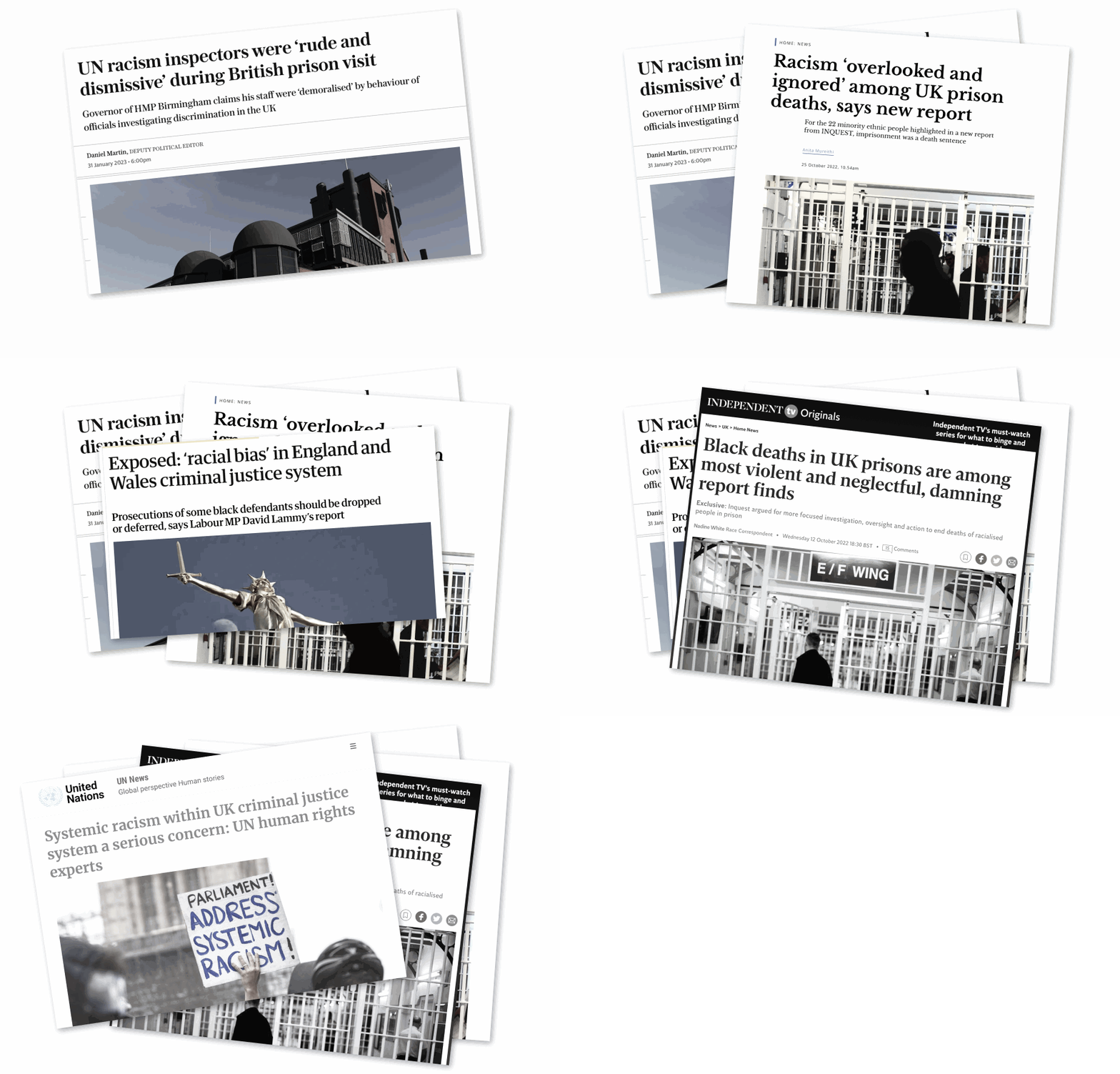
Life in UK prisons took on many hues, however two major themes emerge from Adel’s reflections: the first is the prison staff’s blind obedience to authority; and the second, the rabid racism that permeates the air at every level of the system’s running.
The racial hierarchy of prisoners was clear. White at the top (naturally), then Asians, then any non-Muslim ethnic minorities/mixed race, then Blacks, then Muslims at the bottom. If you were Muslim and White or mixed race or Latin American, you go down to the bottom. Do not pass GO. Do not collect £200.
Officers have the power to make life miserable for prisoners, if they are so inclined that way. They can refuse job applications, they can ignore your cell when they take others for gym time, they can arbitrarily refuse permission for phone calls and, if granted, can create and impose time limits on whoever they please. They can change visitor’s protocols and feign ignorance. Like when Adel got clearance for his son and daughter to visit him when his wife was sick, they travelled four hours to be turned away at the door “because their name wasn’t on the list”.
Officers can also refuse prisoners access to showers, they can refuse to provide clean clothes, they can strip cells of the single pillow and sheet provided. If you manage to earn the maximum £12 a week, they can instruct canteen staff not to serve you.
“I had very good relationships with some guards, male and female.
I saw in particular some of the women were surprised in the conversations we used to have,
because their idea of Muslim men was that we hate women.
Guards are human: some were very lovely, some just wanted to do their job and leave,
others were very evil.”
Adel himself used to offer his advice to the prison staff about the “radicalisation” of Muslim prisoners. “I asked them: ‘Do you think you’re helping to stop radicalisation? You’re doing the opposite. When a Black guy becomes Muslim inside, you instantly make his life such Hell and he knows it’s because of his Islam.
When he’s ‘just’ a drug dealer inside, you have a laugh and joke with him, you give him respect and even some privileges here and there.
The second he becomes Muslim, everything changes. You start targeting him. That’s what he sees and so he flocks to the people who hate you.
You are creating the terrorists yourselves.’”
Restricting Adel’s access to communicating with his wife and children was par for the course.
“One reason they would always cite was the use of Arabic in phone calls”, Adel explains. Let’s remind ourselves of something here. Adel is 62 and his wife a couple of years younger. They were born, raised, and lived their entire life speaking their native language.


Though not impossible, speaking to one another in English is challenging at best, and plain unintelligible at worst. Yet, they’d do it. When, one day, his phone rights were taken away again, they played an audio recording of Adel’s last call to show him what he did wrong. It went a little something like this:
“Hello”
“Hello”
“How are you? How is Muhammad? How is Abdul Majeed?”
They paused at the Abdul Majeed,
“There!” It was the gotchya moment.
“Abdul Majeed?
I told them ‘Abdul Majeed is my son’s name, is that the Arabic?
And if it is, then so is Muhammad?
Why didn’t they cut the call on his name?”
It’s hard to articulate what the giving and returning of the greeting of peace (“al-Salāmu ‘alaykum”, “wa ‘alaykum al-Salām”) really means to believers. For Adel and his wife — and pretty much all observant Muslims — this greeting is more than just a protocol. It is nothing less than a greeting of Paradise, designed to invoke the peace, mercy, and blessings of God upon the one you are engaging with.
It is said on arrival and departure. It is part of a believer’s obligation. There are even instructions to offer the Salām again to a family member, if you happen to see them in another room of your house. The significance of the Salām, therefore, cannot be understated.
The prohibition of it, likewise, carries a weight of consequences; the least of which is severing one from the core of their identity. For Adel and his wife to simply begin a phone call with “Hello” is more than just replacing one greeting for another, it is an amputation.
When one of the family prison visits was successful, Adel’s wife had a sniffer dog set on her and — in its enthusiastic display — was pulled back on his lead with the officer saying, “Back now, Allah, back”.
He had named his dog Allah.

When Adel’s youngest daughter came to visit, she would traditionally end her visit by asking: “When are you coming home, Baba?” With no answers to give, Adel’s scripted response would be, “I will come home soon, inshāAllah, inshāAllah soon.” After a few rounds of this Q&A, his daughter piped up,
“I’m going to ask you something now Baba, but don’t say inshāAllah because inshāAllah means it is never going to happen.”
Adel grew close to some of his fellow prisoners, however — especially those who were on similar charges to him.
In prison, Muslims were quite respected as they didn’t make trouble for others. Adel was part of a sub-category of the Muslim prisoners at the time — widely regarded as non-violent political prisoners, often older, too. This meant they were uninvolved in the drugs, drinking, violence, gambling, and theft that would go on within cell doors.
“When people needed help, they knew they could go to one of the Muslim brothers and they’d try to help them out. Generally, the Muslims inside were liked because they were not dodgy, not lying, not getting involved in feuds, keeping a disciplined routine.” Some even became Muslim themselves and, with it, would slide right down the hierarchy of privilege within the prison system.
Seeing family was also tough in prison. Adel’s wife lived in London, had six children, and didn’t drive. Prisons could be across the country with rigid visiting times. Charities sometimes helped Ragha and her children see Adel, with volunteer drivers taking the entire day to drive four to five hours across the UK each way — waiting in the car as the family went in.
Even so, the visits were once every few months. When Adel raised a complaint about his wife not being permitted to be ID’d by a female officer, the prison stopped his family visiting for 1.5 years while they “investigated” the claim.
Though all of Adel’s children came to visit him at certain points in his UK detention, their understanding of their father varied dramatically. His older children had more time in a “normal” family dynamic, whereas his youngest was born two months after he was arrested. How well can you know a dad you have only heard about through your mum and older siblings, a man who cuddles and plays games with you during visits that take four hours of driving every few months?
With all the familiar cheek of the youngest child, Adel’s daughter made her intentions clear to her dad during prison visits:
“You already spent time with them before you went to prison. When you come out, you’re going to live with me alone — just the two of us — don’t spend any more time with them, okay Baba?”
The topic of family is the only time that there is active struggle in Adel’s words. His voice drops, his expression struggles. He opens and closes his mouth multiple times, as if the pain has got his words in a headlock and no matter how many times you tap out, they won’t submit.
“I have to say, all the children, and my wife, they’ve all been affected by prison very much, mentally.
They can be patient, but they have pain, and they live with that pain every day.
There is a reflection of that situation in their mind, in their emotions, in their life journey.
It’s become very hard. Allah made it happen, but it wasn’t easy.”
What does Adel feel knowing that?
“You feel sometimes that you are behind all of this. But then you turn around and see you haven’t done anything wrong yourself. Despite that though, you are the one who has been in this trouble, and they’ve been suffering from it. They look normal on the outside, but you know inside there is nothing normal about the life they’ve lived.”
When I ask if they’ve ever sought help to manage their emotions, Adel immediately says this isn’t a situation for “fixing”. “When you’ve grown with this injury your entire life, you can heal from it somewhat, but the scar will live with you forever.”
Adel is also keenly aware of the unique temperaments of his children, and how they each internalise their struggles. “They all had their difficulties in different ways because of my injury. Each one of them is affected in a hundred different ways. What happened happened, and we had to deal with it. I couldn’t be a full-time father guiding and giving my children advice.
If you have a maximum ten-minute time limit to talk to all of your children on the phone,
what are you really going to say?
They can’t tell you their feelings, their pain, their happiness, their struggles.
They just live with those scars.
We all do.”
On the legal side of Adel’s case, things were not looking good. Rounds of legal precedents, hundreds of hours with solicitors, and years of lodging appeals seemed to be winding in an infinite loop.
The Americans had issued the extradition request in 1999 and it had been a long 13.5 years touring Britain’s prisons while Adel battled it. “If I committed a crime in Britain, try me in Britain. My apparent crime was in the UK, why do I need to face courts there?”
Then final decisions were made: Adel lost his appeal against extradition in Britain and the European Court of Human Rights (ECtHR). Then his appeal was turned down by the Grand Chamber of the ECtHR. The British High Court then threw out Adel’s final challenges and the Grand Chamber of the European Court of Human Rights ruled that he can be sent to the United States to face terrorism charges due to the US-UK extradition treaty.
The record-breaking extradition battle from 1999 to 2012 was all over.
Adel was going to face American justice.


“My fellow Americans,
from the battlefield to the capitals of our allies and friends and partners,
the free peoples of the world look to America as the last best hope for peace and for liberty for all humankind,
for we are the greatest country on this planet.”
John R. Allen