

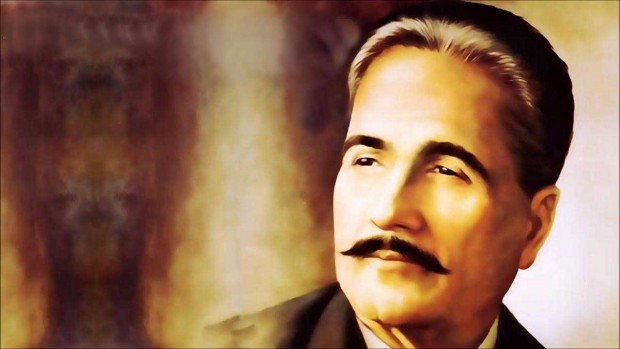
‘Allāma Iqbāl in Oldham A series on Muḥammad Iqbāl
Part 1: On unity and identity
In a quiet neighbourhood in Oldham, Greater Manchester, amidst vibrant greenery and rows of quaint houses lies 31 ‘Allama Iqbāl road. Although it may at first seem an anomaly amongst the other more ‘English’ street names around, Iqbāl’s influence, and indeed his mastery over western thought, render his name perfectly at home in Oldham. Iqbāl’s ideas inspired a political revolution, his academic work greatly contributed to the discourse on Islamic thought, but it is mostly his unique and rock-solid sense of identity that we, as Muslims in the 21st century Britain, are most in need of.

Early beginnings
Iqbāl was born in Sialkot, India. He studied Arabic and the Qur’an at a young age, later graduating with a BA in Philosophy, English, and Arabic literature. After qualifying for a scholarship from the University of Cambridge, he qualified as a barrister in the UK and went on to complete his doctorate in Philosophy in Germany.[1] What makes this discussion valid in 21st century Britain is that Iqbāl’s experience fuses the traditional and contemporary; the Eastern and Western, both in thought and culture.
Poet of the East
One would expect that Iqbāl, having spent many years in institutions like Cambridge’s Trinity College after being educated in Punjab, would attest to the superiority of in the West in terms of its institutions, culture and thought. Surprisingly, this is not the case. One of his poems, a sarcastic portrayal of the West’s superiority, The Wisdom of the West, includes the lament of a man who has died and requests God to send the Angel of Death to the West for training.
The West develops wonderful new skills
In this as in so many other fields
Its submarines are crocodiles
Its bombers rain destruction from the skies
Its gasses so obscure the sky
They blind the sun’s world-seeing eye.
Dispatch this old fool to the West
To learn the art of killing fast—and best.[2]
One very distinct mark in Iqbāl’s writings is his confidence in his ethnic and religious Identity. Given he lived in colonial India, he staunchly believed that colonialism stemmed from nationalism, and he frequently clashed with his contemporaries over his view of nationalism as ‘the greatest enemy of Islam’.[3]
Unity
Iqbāl’s vision of Islam was perforce a simple and pristine one. This notion was of great importance and consequence to Muslim politics of India at the time and, as such, made Iqbāl a central intellectual figure in the drama of the Muslim-Hindu stand-off of the period. For, it was the argument of the British and the Indian National Congress that Muslims of India were not one community, and were so diverse that no one party or leader could claim to speak for them, or to characterise as one people with one aim.
“And one your Kaʹba,
One your God,
And one your great Quran;
Yet, still, divided each from each, Lives every Mussalman.
You split yourselves in countless sects,
In classes high and low;
Think you the world its gifts will still
On such as you bestow?
You are known as Syed, and Mughal,
you call yourselves Pathan;
But can you truly claim as well the name of Mussalman?”[8]
At a time when us Muslims are divided into numerous labels, the idea that we need to unite, especially to cooperate in initiatives that unite us, is perhaps as necessary in our era as it was in his.
East vs West: Iqbāl’s legacy
Throughout his life Iqbāl grappled with the religious, social, and political implications of the occlusion of Islam in his homeland. For Iqbāl, the question was not that of choosing between the East and West but rather to find a middle ground where Muslims do not have to abandon their Islamic identity to be part of the modern world. The Muslim future does not just depend on gaining Western knowledge but also by balancing this knowledge against their own tradition. The native under colonial rule, for Iqbāl, is not just fighting for or appealing for inclusion in the colonial system; he is, rather, offering his own system as a solution to the problems of the colonial masters.[5]
For Iqbāl, the encroachment of the West was an experience being shared by almost all Muslims, and so there was an increasing need to find a sense of identity as they grappled with the meaning of the modern state in colonial form.[6] What concerns us, then, and what pained him most was the impact of nationalism on various Muslim countries, eroding the concept of “Ummah”, enfeebling the Muslim world, and laying it open to European aggression and exploitation.[7]
In part 2 of this series on Iqbāl, we will explore some of his Arabic poetry, his thirst to understand and explore the Qur’ān and sunnah, and his understanding of identity in an increasingly chaotic world.
[donationbanner]
Source: www.islam21c.com
Notes:
[1] Seyyed Vali Reza Nasr, Iqbāl’s impact on contemporary understandings of the Islamic polity
[2] Iqbāl, PaymeTahriq
[3] Sevea, Iqbāl Singh. The Political Philosophy Of Muhammad Iqbāl . Cambridge: Cambridge University Press, 2012. Print.
[4] Mustansir Mir, Iqbāl
[5] Masood A.Raja, Islam, the West, and the Quest for a Modern Muslim Identity
[6] Masood A.Raja, Islam, the West, and the Quest for a Modern Muslim Identity
[7] Sharif al Mujahid, Iqbāl’s synthesis of PanIslamism and Nationalism
[8] Iqbāl, Jawabeshikwah


His “mastery over Western thought”? Never heard of the guy. Sounds like he was a master in his own mind. He actually should have been thankful that he had the opportunity to study in some of the West’s fine institutions of learning. Because the ones in the East are certainly scarce and of poor quality.
There are numerous reports that Iqbal also became a Ahmedi as he was greatly influenced by Ghulam Ahmed and his teaching.
He reverted back to Sunni Islam before his death but it’s important to raise this fact about him.
Muslims, especially the ones from Pakistan need to stop treating him like a scholar given the errors that he made with accepting the Ahmedis and giving their beliefs more credibility
There are no such reports and Iqbal never became a Qadiani (wrongly called “Ahmadi”). Do not spew their propaganda. Iqbal was alqays against Qadianism. Iqbal was a Sunni and remained a Sunni and praised Ala Hazrat Ahmed Taza Khan (rah).
Al Seenu lanaa,wal hind lanaa wal arbu lanaa wal KULLU LANAA
We are as Allaamaah Iqbaal alludes to,inheritors of this world.
We need to be more like him when we study away from home.Unaffected,maybe even stronger in faith.
Beard we can just about excuse for being an islambouli in words.
I profess ignorance of the vast majority of his work but the little I have read only points a finger to a person who had complete superiority complex of his faith.
Iqbal’s poetry is awesome but it loses its force when rendered in another language. Can you please provide the original text alongside the translation, if you could that would be great. In particular references 2 & 8.
Thanks
All books urdu and persian with translation.
http://allamaiqbal.com/
Jazakallahokhairan for this excellent article on the Allama Muhammed Iqbal of Sialkot.
Look forward to reading the second part